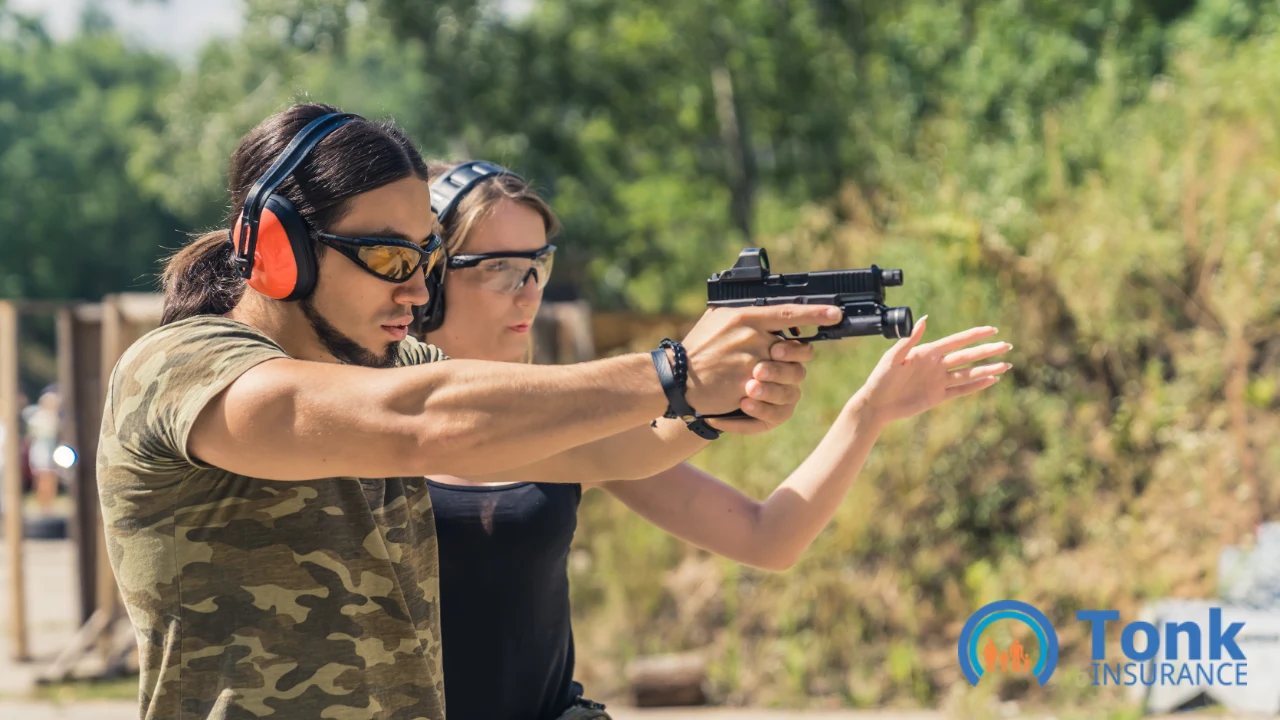
Are you searching for firearms instructor insurance to protect your training business from liabilities or accidents that can occur during range sessions, classroom work, or private lessons?
Most ranges will not let you teach without $1,000,000 per occurrence and $2,000,000 aggregate on file. They also want the range named as an additional insured. That requirement, not the premium, usually decides whether you can work a given site.
Cindy’s Hot Shots in Maryland publishes that exact minimum for outside instructors, and the trade association SAFTEA asks for a certificate showing at least $1,000,000 in general liability limits.
Now the fact that catches most new instructors. Your homeowners policy will not cover you. The standard homeowners form excludes bodily injury arising out of a business you engage in, and teaching for compensation is a business pursuit.
As PropertyCasualty360 explains in its analysis of the business pursuits exclusion, courts test whether the activity was continuous and done for profit. Paid instruction is both.
What firearms instructor insurance covers:
- General liability: third-party injury or property damage during your session, including a bystander struck on the line
- Professional liability: allegations that your instruction itself was negligent, such as a student who later mishandles a firearm
- Medical payments: small third-party medical bills settled without a lawsuit
- Additional insured status: the endorsement that satisfies a range or venue contract
- Personal and advertising injury: claims arising from how you market your courses
This guide walks through the risks you carry and the coverages that answer them. It also covers what each limit tier costs, and what ranges actually check before they let you teach.
Why Is Firearms Instructor Insurance Important?
The exposure is not theoretical. You are supervising people handling lethal tools, often for the first time. A single negligent discharge can produce a catastrophic injury claim.
The deeper problem is the gap most instructors do not know they have. If you teach without a commercial policy, you are personally exposed. The homeowners policy you assumed would respond contains a business exclusion, and the range’s own policy protects the range, not you.
Coverage is a business requirement before it is a safety net. No state requires a firearms instructor to carry liability insurance by law, so the binding requirement comes from range contracts rather than statute. That distinction matters, because it means the paperwork gate is set by whoever owns the facility you teach at.
Instructor certification is state-regulated and varies widely, with no federally recognized standard. Your certification proves competence. It does not transfer risk. Only a policy does that.
Associated Risks with Firearms Instructor Insurance
Every element of a training session carries a distinct exposure, and they do not all resolve to the same coverage.
- Negligent discharge: a student’s round injures another student, a bystander, or you
- Failure to supervise: a claim that you allowed an unsafe condition on the line to continue
- Negligent instruction: a former student causes harm and alleges your training was inadequate
- Range property damage: damage to baffles, backstops, target systems or the structure itself
- Classroom incidents: slips, falls and injuries during the non-shooting portion of a course
- Equipment loss: theft or damage to the firearms, optics and training aids you supply
- Advertising claims: disputes over how you describe your credentials or course outcomes
The last one surprises people. Personal and advertising injury coverage answers claims about your marketing, which is why the coverage appears in instructor programs at all.
Types of Firearms Instructor Insurance Coverage
Instructor programs commonly bundle general and professional liability, because a training claim can plausibly be pleaded as either.
General Liability
This is the coverage ranges check for. It answers third-party bodily injury and property damage arising from your operations. So a bystander injury or damage to the range structure falls here.
Standard limits are $1,000,000 per occurrence and $2,000,000 aggregate. The per-occurrence number caps any single claim. The aggregate caps what the policy pays across the whole term, which matters if you have a bad year rather than a bad day.
Professional Liability
Professional liability answers a different question: not whether someone got hurt on your line, but whether your instruction was competent. A student who later mishandles a firearm and alleges your training was negligent triggers this coverage, not general liability.
Lockton Affinity Outdoor and Delta Shield both bundle professional liability with general liability in their instructor programs. Treat it as core rather than optional, because the negligent-instruction claim is the one most specific to what you do.
Medical Payments
Medical payments coverage settles minor third-party medical bills without anyone filing suit. Instructor programs commonly include $5,000 of it, and both Lockton and Delta Shield publish that figure with no deductible.
It is a small number that prevents a small incident from escalating into a liability claim.
Additional Insured Status
An additional insured endorsement extends your policy to the range, so the range’s contract requirement is satisfied by your coverage. This is administrative, and it is also the single most common reason an instructor gets turned away at the door.
Cindy’s Hot Shots asks for roughly 72 hours to process the paperwork. It states plainly that instruction cannot take place on an expired policy. Shoot Indoors in Denver requires the range added as additional insured well in advance.
Build that lead time into your scheduling. If you need a certificate issued for an upcoming class, contact our team and we will tell you what your policy allows before you commit to the booking.
Firearms Instructor Insurance Cost
Cost tracks the limit tier you buy, which is how the instructor programs themselves structure their pricing. The table below reflects published figures from three independent programs.
| Coverage | $250K/$500K tier | $500K/$500K tier | $1M/$2M tier |
|---|---|---|---|
| General + professional liability | $150/yr | $225/yr | $300 to $400/yr |
| Medical payments | $5,000 included | $5,000 included | $5,000 included |
| Additional insured endorsement | $0 to $25 per location | $0 to $25 per location | $0 to $25 per location |
| Force-on-force endorsement | not typically offered | optional | $150/yr |
| Simunition instructor endorsement | not typically offered | optional | $150 per instructor |
| Comprehensive package | $150 to $200/yr | $225 to $300/yr | $300 to $550/yr |
Costs current as of August 2026. Figures are published program rates from Lockton Affinity Outdoor, Delta Shield and SAFTEA, not Tonk Insurance quotes. Actual costs vary based on your state, class volume, course types, claims history and the endorsements you need.
The $1M/$2M row is the one most instructors end up buying, because it is the limit ranges ask for. Buying a lower tier to save $150 a year is a false economy if it means you cannot teach at your primary range.
What Ranges Require for Firearms Instructor Insurance
Range requirements are remarkably consistent, and they are contractual rather than statutory.
- $1,000,000 per occurrence and $2,000,000 aggregate. Confirmed independently across multiple range and association requirement pages.
- The range named as additional insured. Every location you teach at must appear on the policy, not just your primary one.
- A current certificate of insurance on file. An expired policy stops instruction immediately.
- Lead time to process. Around 72 hours is typical, and some ranges ask for more.
Name every range you teach at. Instructors who travel between facilities routinely forget this, and the endorsement only extends to locations actually listed. Lockton Affinity includes two named locations at no charge and adds roughly $25 for another, while Delta Shield advertises no charge for additional insureds or certificates.
Confirm your certificate is current before each new venue, since ranges verify the expiration date rather than assuming it.
How to Choose the Best Firearms Instructor Insurance Provider
Compare on coverage structure and administrative friction, not on headline premium alone.
- Confirm professional liability is included, not just general liability. The negligent-instruction claim is the one most specific to instruction, and a general liability policy alone will not answer it.
- Check how many additional insured locations are free. If you teach at four ranges, a program that charges per location changes the real cost.
- Ask how fast certificates are issued. Your ability to accept a booking depends on it.
- Verify the coverage is admitted in your state. Some programs are not available everywhere, and admitted coverage carries state guaranty fund protection that surplus lines does not.
- Read the eligibility exclusions before you buy. Programs commonly exclude automatic weapons, explosives, international training and force-on-force work unless you buy an endorsement.
- Work with a broker who can compare programs. Tonk Insurance has been licensed since 2003 and places coverage across the United States, so we compare structures rather than sell one.
Certifying and trade bodies such as SAFTEA and the Civilian Marksmanship Program also sponsor member programs. They are worth pricing against an independently placed policy.
Safety Protocols That Lower Insurance Costs
Underwriters price what you can document, so the practices that reduce claims also reduce premium over time.
Training and Certification
Keep your instructor certifications current and hold documentation for every credential you claim. Instructors teaching outside their certified disciplines create both a coverage argument and an underwriting problem.
Range and Equipment Safety
Maintain written pre-session equipment checks. Enforce eye and ear protection without exception, and keep the student-to-instructor ratio low enough that you can actually supervise the line. Ratio is the control underwriters ask about most.
Written Protocols
Put your safety rules, emergency procedures and medical response plan in writing, and brief them at the start of every course. A documented protocol you can produce after an incident is worth considerably more than an undocumented one you followed.
Documentation
Keep signed waivers, attendance records, course outlines and incident logs. Waivers do not prevent suits, but the paperwork trail establishes what you taught and what the student acknowledged.
Frequently Asked Questions about Firearms Instructor Insurance
How much is firearms instructor insurance?
A $1,000,000 per occurrence and $2,000,000 aggregate instructor policy is published at roughly $300 to $400 a year. Lockton Affinity Outdoor lists $300 at that limit, Delta Shield advertises from $397 and SAFTEA publishes $375 per instructor. Lower tiers start near $150 a year, and your own cost varies by state and class volume.
Does homeowners insurance cover firearms instruction?
Homeowners insurance does not cover firearms instruction for compensation. The standard homeowners form excludes bodily injury arising out of a business engaged in by an insured, and paid teaching qualifies as a business pursuit. Instructors relying on a personal policy are effectively uninsured for their teaching, so a commercial policy is required.
Is firearms instructor insurance required by law?
Firearms instructor insurance is not required by law in any state. The requirement comes from range and venue contracts instead, and most ranges will not let you teach without $1,000,000 per occurrence coverage naming them as additional insured. In practice that contract binds you as firmly as a statute would.
What limits do gun ranges require from instructors?
Gun ranges typically require instructors to carry $1,000,000 per occurrence and $2,000,000 general aggregate. Cindy’s Hot Shots publishes that exact minimum for outside instructors, and SAFTEA requires a certificate showing at least $1,000,000. Ranges also require being named as an additional insured before instruction begins.
What is the difference between general and professional liability for instructors?
General liability covers third-party bodily injury and property damage during your session, such as a bystander struck on the line. Professional liability covers allegations that your instruction itself was negligent, such as a former student who mishandles a firearm. Instructor programs commonly bundle both, because a claim can be pleaded either way.
Does my insurance cover every range I teach at?
Coverage for each range depends on how your program handles additional insureds. Lockton Affinity includes two named locations at no charge and charges roughly $25 for another. Delta Shield states that locations requiring additional insured status by written contract are covered automatically. Confirm which model your policy uses before teaching at a new facility.
How long does it take to get a certificate of insurance?
Ranges commonly ask for around 72 hours to process a new certificate and update their records. Cindy’s Hot Shots states that timeline explicitly and will not permit instruction on an expired policy. Request your certificate well before the class date rather than the morning of, and confirm the range received it.
What type of liability insurance is recommended for instructors?
Instructors are generally advised to carry general liability and professional liability together, at $1,000,000 per occurrence and $2,000,000 aggregate. General liability answers injury on your line, while professional liability answers claims that the instruction itself was negligent. Force-on-force and Simunition work usually needs a separate endorsement, commonly around $150 a year.
Who needs firearms instructor insurance?
Firearms instructor insurance covers anyone who trains others for compensation, including certified instructors, training counselors, coaches and range safety officers. Programs generally cover private sector firearms training, security guard instruction and some law enforcement or military training. Part-time instructors teaching a handful of classes a year need it just as much as full-time ones.
Conclusion
Firearms instructor insurance is what makes your teaching business viable. That is because the range contract requires it and your personal policy will not answer a claim arising from paid instruction.
Buy the $1,000,000 per occurrence and $2,000,000 aggregate tier, confirm professional liability is bundled with general liability, and name every range you teach at as an additional insured. Those three decisions handle the great majority of what goes wrong.
If you teach at a range, run private lessons, or train security personnel, request a quote from Tonk Insurance and we will compare instructor programs against your actual course catalog and range list. We also write coverage for related instruction-led trades including archery, martial arts, jiu jitsu programs.
If you also teach a lower-impact discipline, the same additional insured paperwork applies, and our guide to tai chi instructor insurance walks through what city recreation departments ask for.
Instructors who also run guided hunts or backcountry trips need cover for that side of the business, since guiding and instruction are underwritten differently. Our guide to outfitter and guide insurance covers what land agency permits require.
Instructors who run courses on private ground face a different exposure, because charging for access changes what the landowner owes. Our guide to hunting lease insurance covers how that shifts the liability.