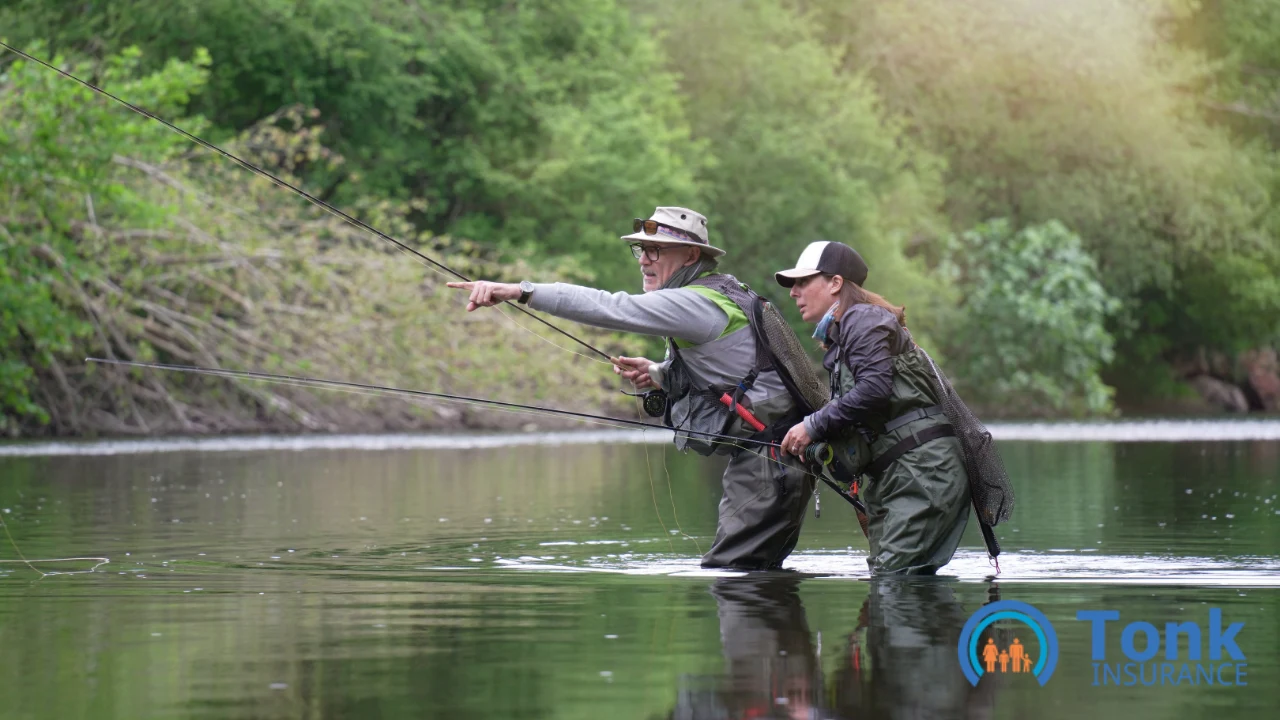
Are you looking for fishing guide insurance to protect your charter business from injuries, gear losses and liability claims that can happen on any trip?
General liability starts near $395 a year, and if you guide from a boat you own it excludes your biggest exposure. The standard form rules out bodily injury arising from watercraft you own or operate. That is Exclusion G of the ISO general liability form, and it holds even when a claim is pleaded as negligent supervision.
So the policy most guides buy first answers claims on land, at the launch and around your operation. It does not answer the ones that happen aboard.
Protection and indemnity is the coverage written to answer it. The Insurance Information Institute says it covers owners for injury and damage that arise from the vessel.
Two more gaps catch guides out. Your policy probably does not cover clients riding in your truck, so the drive to the launch needs commercial auto. And a deckhand who counts as crew falls outside workers compensation entirely.
What fishing guide insurance covers:
- General liability: client injuries and property damage on land, at the launch and around your operation
- Protection and indemnity: liability for injury arising from the vessel you own and operate
- Hull and vessel: physical damage to the boat, motor and trailer
- Professional liability: claims that your instruction or judgment caused a loss
- Inland marine: rods, reels, electronics and tackle, wherever they travel
- Crew coverage: the Jones Act exposure you create when you hire a deckhand
Below you will find what drives the cost, what launch sites and agencies require, and how to compare providers.
Why Is Fishing Guide Insurance Important?
Guiding puts paying clients on moving water with hooks, motors and weather. That combination is why the federal government regulates it and why launch sites ask for proof of coverage.
The moment a client pays you, the rules change. Under 46 CFR 24.10-1, a vessel under 100 gross tons carrying at least one passenger-for-hire becomes an uninspected passenger vessel. It is capped at six passengers, which is where the “six-pack” name comes from.
That single fact reshapes your exposure. You are no longer a boater taking friends out, so your recreational boat policy will likely not respond to a client claim. The Coast Guard also requires the operator to hold an OUPV credential.
Insurance is what stands between one bad afternoon and the end of your season. Because most guides are owner-operators, a single injury claim can exceed a year of revenue.
Associated Risks with Fishing Guide Insurance
Every guided trip carries risks a homeowners or recreational boat policy was never written to handle.
- Client injury: hook wounds, slips on wet decks, falls while wading and heat or cold exposure
- Vessel incidents: collisions, groundings, engine fires and capsizing in unexpected water
- Gear loss: rods, reels, motors and electronics damaged in transit or dropped overboard
- Transport exposure: accidents while hauling clients or towing a trailer to the launch
- Professional claims: a client alleging your route choice or instruction caused their loss
- Weather: sudden storms, rising water and conditions that turn a routine float dangerous
The drive is the risk guides tend to miss. You may drive clients to a remote put-in every day of the season without realizing your policies treat that drive differently than the fishing.
Types of Fishing Guide Insurance Coverage
Guide programs are built from separate parts. Knowing which part answers which claim helps you spot the gaps.
General Liability
This is the core of any guide program and the coverage launch sites ask about. It responds when a client is injured or their property is damaged and you are held responsible.
Cross Current’s program writes $1 million each occurrence and $2 million aggregate, plus $2 million products and completed operations. It also includes $100,000 damage to rented premises and $5,000 medical expense per person.
Protection and Indemnity
Protection and indemnity is the part of fishing guide insurance that answers vessel injury claims. Guide from a boat you own and this is the policy that responds when a client is hurt.
Carriers usually write it next to hull cover. Ask for it by name. The general liability policy you already hold is built to exclude this exact claim.
Crew Coverage and the Jones Act
Fishing guide insurance rarely covers your crew by default. Hire someone to work your boat and you may create an exposure workers compensation does not answer. The Department of Labor states that the Longshore and Harbor Workers Compensation Act excludes a master or member of a vessel’s crew.
Crew members fall under the Jones Act instead. It gives an injured seaman a negligence claim against the employer. The two regimes are mutually exclusive, so settle one question before the season: does your help count as crew?
Professional Liability
General liability handles the physical accident. Professional liability answers a different question. It responds when a client says your advice or route choice caused their loss.
Mosaic quotes general and professional liability together for a solo freshwater guide. On a drift boat the two tend to move as one.
Equipment and Inland Marine
Your rods, motors and electronics need their own protection because liability coverage does not pay for your gear. IRMI defines inland marine as property insurance for goods in transit and movable equipment that no fixed location contains.
Read this section carefully before you rely on it. Cross Current’s property protection applies only during commercial use, so gear damaged on a personal trip may not be covered.
Hull and Protection & Indemnity
Larger saltwater boats need marine lines of their own. Hull covers the vessel. P&I picks up crew injury and pollution, which general liability leaves out.
Program limits vary here more than anywhere else. Cross Current caps boats at 26 feet, but that number is one program’s rule and not an industry standard, so confirm the cutoff with your own carrier.
Additional Insured
Marinas, lodges, fly shops and land agencies routinely ask to be named on your policy. The endorsement is administrative, yet it is often what decides whether you launch.
Treatment varies by who is asking. Cross Current adds government entities at no charge but bills $25 for private businesses, and that fee is program-specific. If a lodge is waiting on paperwork, contact our team and we can walk through what your certificate needs to say.
Fishing Guide Insurance Cost
What you pay depends far more on your water and your vessel than on your years of experience. A drift boat guide and a saltwater charter captain are in different pricing worlds.
| Coverage | $300K (state licence floor) | $500K CSL (typical permit) | $1M/$2M (common contract ask) |
|---|---|---|---|
| General liability | $450 to $700 | $600 to $1,100 | $800 to $1,600 |
| Protection and indemnity | quote required | $700 to $1,800 | $1,200 to $3,000 |
| Professional liability | bundled with GL from $1,100 | bundled | bundled |
| Inland marine, gear | $150 to $400 for $10,000 to $25,000 scheduled | same | same |
| Hull and vessel | rated on hull value, commonly 1.5% to 3% | same | same |
| Crew coverage | quote required, rated on payroll and waters | same | same |
| Comprehensive package | $1,300 to $2,400 | $1,900 to $4,200 | $2,800 to $7,500 |
Costs current as of September 2026. Figures reflect published industry entry points from Cross Current Insurance, Mosaic Insurance Alliance and Insuranks, and are not Tonk Insurance quotes. Actual costs vary based on your waters, vessel value, passenger count, crew, claims history, trip volume and licensing state.
The table segments by limit because that is how gatekeepers ask you to prove coverage. Insuranks reports an average near $984 a year for $1 million in general liability. Mosaic’s Washington figures show why averages mislead, because a 30-foot twin-engine charter can pay six times what a drift boat guide pays.
What Launch Sites and Agencies Require for Fishing Guide Insurance
Requirements come from three directions at once, and they do not always agree.
Federal. The Coast Guard requires an OUPV credential to carry passengers for hire. That means 360 days of documented sea service, with 90 days on near-coastal waters for that endorsement, plus first aid and CPR certification and a Merchant Mariner Medical Certificate.
State. Licensing sits on top of the federal credential, and some states make insurance a condition of the licence itself. Washington’s Department of Fish and Wildlife requires a certificate of commercial liability coverage of at least $300,000 before it issues a charter or guide licence.
Washington also splits registration into Food Fish, Game Fish and Combination Guide categories. Cross Current reports Alaska setting a floor of $100,000 each incident and $300,000 a year. It also sells guide bonds for California, Colorado, Idaho, Oregon and West Virginia. Check your own state, because there is no national standard.
Private and local. Mosaic notes that most insurers look for at least $500,000 per occurrence, and that port authorities commonly mandate $1 million. Marinas, lodges and land agencies set their own floors too.
Always confirm the limit in writing before your first trip of the season. Because agencies rarely publish these thresholds, guides often discover them the morning a certificate is due.
How to Choose the Best Fishing Guide Insurance Provider
Comparing guide programs is harder than comparing prices, so work through these in order.
- Confirm the passenger and vessel limits. Programs cap boat length and passenger count differently, and a cap below your operation makes the price irrelevant.
- Ask what commercial use means. If property cover switches off outside guided trips, you need to know that before a claim.
- Check auto separately. Most guide liability excludes clients riding in your vehicle, so ask your auto insurer about business use.
- Test the certificate process. Ask how additional insured requests are handled and what they cost.
- Match limits to your launch sites. Buy to the highest limit any agency you work with requires.
- Confirm multi-state coverage. Cross Current covers all 50 states and territories, but not every program does.
- Review the deductible. Cross Current sets property at $1,000 per claim with no lower option.
A broker who writes outdoor recreation regularly will know which programs cap at 26 feet and which do not. That knowledge saves more money than shopping premium alone.
Safety Practices That Lower Insurance Costs
Underwriters price the operation in front of them, so documented safety habits work in your favor.
Training and Certification
Keep your OUPV current and your first aid and CPR certifications in date. Add swiftwater rescue or wilderness first responder training if you guide remote water, because both signal lower risk.
Equipment and Vessel Maintenance
Service motors on schedule and keep records. Inspect PFDs, throw bags and safety gear before each season, and replace anything worn rather than carrying it another year.
Trip Protocols
Run a consistent safety briefing before every trip and document that you did. Set clear weather and water level thresholds for cancelling, then hold to them.
Documentation
Use signed liability waivers on every trip and keep them for the period your state requires. Maintain a trip log with conditions, passenger counts and any incidents, because good records shorten claim disputes.
Frequently Asked Questions about Fishing Guide Insurance
Do you need insurance to be a fishing guide?
Insurance is not always a federal licence condition. In practice you still need it. Marinas, lodges, land agencies and booking platforms all ask for proof before letting you operate. Mosaic notes that port authorities commonly mandate $1 million per occurrence, so most working guides carry at least that.
How much does fishing guide insurance cost per year?
Fishing guide insurance commonly runs from $395 a year at the entry level to around $1,600 for a solo guide carrying both general and professional liability. Insuranks reports an average near $984 for $1 million in general liability. Saltwater charters with bigger boats pay a lot more.
Does fishing guide insurance cover clients riding in my truck?
Fishing guide insurance usually does not cover clients riding in your truck. Guide liability policies commonly exclude auto liability when clients are in your vehicle, and Cross Current states this directly in its program FAQ. You need commercial auto, or business use added to your personal auto policy, to close that gap.
What is a six-pack license and do I need one?
A six-pack refers to the Coast Guard OUPV credential. Under 46 CFR 24.10-1, a vessel under 100 gross tons carrying a paying passenger becomes an uninspected passenger vessel limited to six passengers. If clients pay you to take them out, you need that credential.
Does my regular boat insurance cover guided trips?
Your regular boat insurance almost certainly does not cover guided trips. Recreational boat policies exclude commercial use, and taking paying clients is commercial use. Cross Current says its guide property cover applies only while you work. So the two policy types cover opposite cases.
How much liability coverage do fishing guides need?
Fishing guides commonly need $1 million each occurrence with $2 million aggregate, which is the working standard. Mosaic notes most insurers look for at least $500,000, but port authorities and land agencies commonly require the higher figure. Buy to the highest limit any site you work requires.
Is my equipment covered when it is not a guiding day?
Your equipment is often not covered when you are not guiding, and this surprises guides regularly. Cross Current’s property protection applies only during commercial use, so gear damaged on a personal outing may fall outside the policy. Ask your carrier how it defines commercial use.
Can I add a lodge or fly shop as additional insured?
You can add a lodge or fly shop as additional insured, and the request is routine. Cross Current adds government entities at no charge and bills $25 for private businesses, though fees differ by program. Ask about turnaround before your season starts, because certificates gate access.
Does one policy cover me in multiple states?
Whether one policy covers multiple states depends on the program you buy. Cross Current covers operations in all 50 states and US territories, which suits guides who follow seasons across state lines. Ask about multi-state cover up front. State licensing and bonding still apply on their own.
Does general liability cover a client hurt on my boat?
General liability usually does not cover a client hurt aboard a boat you own. The standard form rules out injury that arises from a boat you own or run. That holds even when a claim blames poor training. Protection and indemnity is the coverage written to answer vessel injury claims.
Does workers compensation cover my deckhand?
Workers compensation often does not cover a deckhand who counts as crew. The Department of Labor confirms that federal longshore coverage excludes a vessel’s master or crew, and the Jones Act provides their remedy instead. Because the two regimes are mutually exclusive, confirm how your help classifies before the season.
Can I just self-insure and skip a policy?
You cannot self-insure where coverage is a licence condition. Washington wants a certificate of commercial liability before it issues a guide licence. Federal land permits want one that names the US Government as additional insured. Self-insuring does not produce the certificate those gatekeepers ask to see.
Is liability insurance enough, or do I also need indemnity cover?
Liability insurance answers the physical accident, and professional liability answers the advice. Also called indemnity or E&O, it responds to a claim that your guidance or route choice caused a loss. Most working guides carry both. Mosaic quotes them together for solo freshwater guides, which is why the two lines usually move as a pair.
Can one policy cover fishing trips plus other water tours?
A mixed operation needs the policy built around every activity you run, not just the fishing. Kayak tours, wildlife trips and gear rental each carry their own exposure, and an activity left off the application may not be covered. List every service you offer when you apply, because undeclared operations are a common reason claims get denied.
Conclusion
Fishing guide insurance protects the business you have built one trip at a time. The right program pairs general liability at the limits your launch sites ask for with professional liability and gear cover. It also gives you a clear answer on hauling clients.
Start by confirming what your marinas and agencies require, then build the program to that number. Guides running similar water risk often compare notes with kayaking insurance and white water rafting insurance, and captains running larger vessels should look at sailing insurance too.
Remember that a certificate request usually arrives with little notice, so it pays to have your coverage settled before the season starts. Contact Tonk Insurance for a quote built around your water, your vessel and the agencies you work with.
—
What I tell guides who call us
Harminder Tonk, Licensed Insurance Broker (License #0D97527)
If you own the boat you guide from, ask for protection and indemnity by name. The liability policy most guides buy first is written to exclude injury arising from a vessel you own, so the claim your clients are most likely to bring is the one it answers least.
Price the drive too, not just the day on the water. Guides compare liability quotes carefully, then haul clients to a remote put-in in a personal truck all season, and that drive is often the widest gap left in the program.
The second thing worth checking is what your policy means by commercial use. Gear coverage that switches off when you are not guiding is a narrower promise than it sounds, so read that clause before you need it.
Buying a $300,000 limit to save a few hundred dollars is also a false economy. If the marina or lodge you launch from requires $1 million, the cheaper policy does not let you work there at all.